A homily for the Fourth Sunday of Advent, December 19, 2021
Mi 5:1-4a, Heb 10:5-10, Lk 1:39-45
As the Advent season of waiting nears its end for 2021, one key question remains:
What are we waiting for? Or for whom?
Certainly not Godot.
A homily for the Fourth Sunday of Advent, December 19, 2021
Mi 5:1-4a, Heb 10:5-10, Lk 1:39-45
As the Advent season of waiting nears its end for 2021, one key question remains:
What are we waiting for? Or for whom?
Certainly not Godot.
A homily for the Third Sunday of Advent, December 12, 2021
Zep 3:14-18a, Phil 4:4-7, Lk 3:10-18
They go together like Snap, Crackle and Pop:
Faith, Hope and Charity (or Love).
And they’re both the best way to start the day, every day.
Of course, one of these indispensable triads is a lot holier than the other.
A homily for the Second Sunday of Advent, December 5, 2021
Bar 5:1-9, Phil 1:4-6, 8-11, Lk 3:1-6
Sometimes a twisty road is the one to take.
A twisty road might hug a riverbank or an ocean shoreline. It might wrap around the side of a mountain or follow the contours of a valley. It may be twisty because it’s zig-zag terraced up the side of a hill, and that was the safest way to get the path to the other side.
More simply put, a road with plentiful curves often hews to the reality that nature — and God — laid out.
A homily for the First Sunday of Advent, November 28, 2021
Jer 33:14-16, 1 Thes 3:12—4:2, Lk 21:25-28, 34-36
In 1965, John McPhee’s book profiling Bill Bradley, “A Sense of Where You Are,” hit the shelves. In it, the then-student athlete at Princeton University explained how he was able to accurately fire a basketball through the hoop by maintaining, literally, a sense of where he was on the court.
Bradley, who distinguished himself as an Olympian, a New York Knick, a U.S. senator from New Jersey and a true statesman — among innumerable accomplishments — has kept that sense of where he is not only physically but emotionally, psychologically and spiritually throughout his life and career.
Advent challenges us to do the same.
A homily for the Thirty-Third Sunday in Ordinary Time, November 14, 2021
Dn 12:1-3, Heb 10:11-14, 18, Mk 13:24-32
Judy Garland sang it:
So always look for the silver lining
And try to find the sunny side of life
Today’s Scripture passages are none too sunny as we close out Ordinary Time and the year of Mark’s Gospel.
Frankly, “gloom and doom” only begin to categorize them.
So let’s look for the silver lining and the sunny side.
A homily for the Thirty-Second Sunday in Ordinary Time, November 7, 2021
1 Kgs 17:10-16, Heb 9:24-28, Mk 12:38-44 or 12:41-44
Shortly after I started college, I turned my back on the church. Oh, I’d drop in occasionally to the Sunday evening everybody-sits-on-the-floor-around-the-guitarist Mass in the private dining rooms opposite the main cafeteria, but for the most part, I stopped being a church-goer.
I wasn’t being lazy, and I hadn’t lost my faith or sense of spirituality. (I wound up minoring in theology.) But I was annoyed at my home parish’s incredible preoccupation with money. Well, anyway, that’s how I perceived it.
A homily for the Thirty-First Sunday in Ordinary Time, October 31, 2021
Dt 6:2-6, Heb 7:23-28, Mk 12:28b-34
Let’s imagine for a minute that it’s Christmas, and we’re 10 years old.
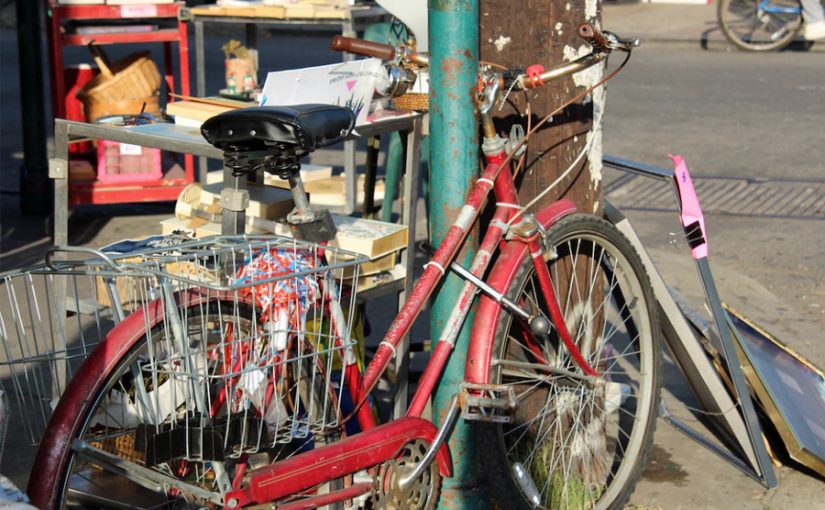
Our favorite uncle has given us the bicycle we’ve been dreaming about — shiny, painted in a red-and-gold sunburst, custom seat and no training wheels.
We throw our arms around Uncle Joe and say, “Thankyouthankyouthankyou!” about a hundred times.
We grab our coat, wheel our prized new bike out into the December chill — which we don’t feel at all — and pedal around the block a few times.
Just like Ralphie in the movie, this is the best present we ever got or would ever get.
A homily for the Thirtieth Sunday in Ordinary Time, October 24, 2021
Jer 31:7-9, Heb 5:1-6, Mk 10:46-52
What makes a good photo?
Composition, yes. Lighting, indeed. The right subject, absolutely.
Focus? Essential.
The same is true when we look. Look, and not merely see. Because the act of looking adds focus to all the visual inputs that can bombard us when we open our eyes.
A homily for the Twenty-Ninth Sunday in Ordinary Time, October 17, 2021
Is 53:10-11, Heb 4:14-16, Mk 10:35-45
It’s such a cliché: “Walk a mile in someone else’s shoes.” The activity is supposed to give us a sense of what it’s like to be that person, or a person of that person’s ethnicity, or socioeconomic situation, or belief system, but it’s a fundamentally flawed exercise.
I am not, and never will be, anything but a white male human descended from Irish-Welsh-French-Alsatian-Croatian-Slovak stock, raised in the suburban dead center of New Jersey, educated at Catholic grammar and boys prep schools in that aforementioned Central Jersey and at a small, private liberal arts college in the rural dead center of Pennsylvania.
Put me in Manolo Blahnik shoes and I will not be a supermodel. Put me again in work boots atop a pile of hot asphalt and I may labor but I will not be a laborer. Put me in moccasins and — at best — I am guilty of cultural appropriation.
We may try, we may try with every fiber of our being, to walk a mile in someone else’s shoes, but in the end, the most we can hope for is partial enlightenment.
A homily for the Twenty-Eighth Sunday in Ordinary Time, October 10, 2021
Wis 7:7-11, Heb 4:12-13, Mk 10:17-30
It’s still possible to buy a needle threader, an incredibly brilliant yet simple tool that helps people with unsteady hands or so-so eyesight — or without the patience and tolerance for frustration — to pass a thread through the eye of a needle.
The fine wire goes through the eye first, and then the thread gets slipped through the lasso-like diamond on the other side.
A quick tug on the handle — or whatever it’s called — and the fine wire lasso hauls the thread through the eye.
Of course, you have to get the needle threader’s wire lasso through the eye first, but pound for pound that’s a far smaller challenge than jabbing a limp, frayed string through a tiny metal oval.
And, no, using a tool is not cheating.