Traveling light, or maybe not

A homily for the 14th Sunday in Ordinary Time, July 7, 2019

It’s a school day, perhaps, or a workday, and you’re running late.

OK, that never happens, but try to imagine.

You bolt out the door, head for the steps and, Oh no!

Lunch! You forgot your lunch!

Or … raincoat. Or those papers. Laptop.

Oh, jeez … keys!

Think quick: What do you do?

You can buy lunch later; besides, you weren’t in the mood for avocado today, anyway.

The forecast said only 20 percent chance. That’s worth a gamble. Ditch the coat.

So off you go; maybe you can make up some time on the Parkway.

Gotta have those papers, though. The laptop? Don’t even think about leaving that. And keys? I sure hope the door didn’t lock behind you before you remembered.

In other words, these things are essential. Can’t do without ’em. Gonna be late? Oh well; doesn’t matter. It’s not just the American Express card that you don’t leave home without. Not these days, nope.

To win the rat race, some things are essential.

Let’s leave school and work behind for a second, and consider this:

It’s summer at the Shore once again, and for many of us, that means vacations and staycations. Trips and day trips. And those mean checklists.

Oil change, tire pressure, A/C working? Check. Beach towels, sunscreen, baby wipes, fruit snacks? Double-check.

Essentials.

“Essential” is an odd concept. It means different things to different people. It affects people in different ways, drives people in often vastly different ways.

Some people decide early in their lives what they consider essential; they set their goals and work toward them. For others, essential requires continual re-consideration. Experience brings wisdom, and wisdom defines how those people mold and reshape their lives to tackle the world’s challenges and succeed.

Essential.

When we strip our lives down to their essence, what do we have? What do we need? What is just stuff?

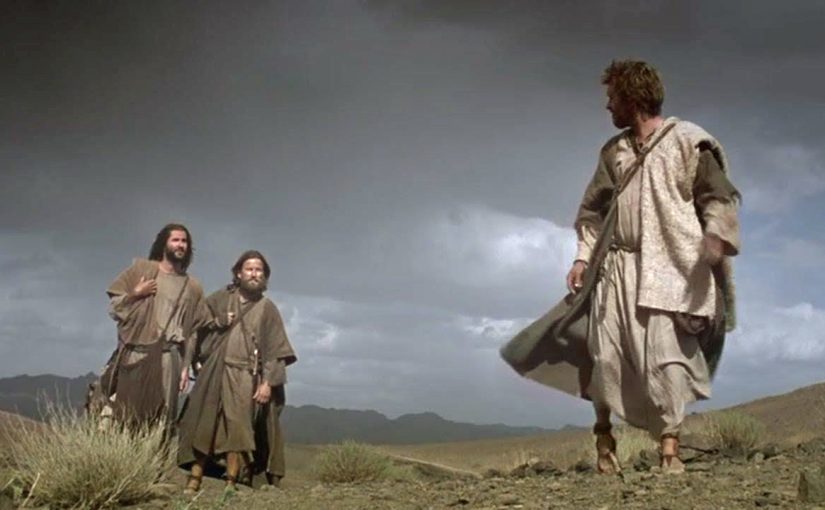
Relationships are essential. Jesus sent the 72 disciples ahead of him in pairs, as traveling companions, 36 essential relationships, to go and form additional relationships in the towns they visited. Those new, added relationships, built on compassion and hospitality, enabled the six dozen early preachers to go forth with no backpacks or hiking boots or even turkey jerky to sustain them.

Wherever they faced no compassion, no hospitality, they moved on, with a little pffft! of displeasure in their wake.

Compassion is essential. The word itself speaks of relationships: Com, as in community. Passion, as in the drive to right wrongs. To cure the sick and drive out demons, to try to ease pain of all sorts. Compassion to recognize and lift up those on the margins of society who have been denied hospitality.

So hospitality, too, is essential. For Jesus’ advance teams, hospitality meant room and board, without getting the best price ahead of time from Trivago. Often it meant an extended stay. And that was fine with the hospitable hosts.

We don’t need to open our homes – although, of course, we can – to show hospitality. Sometimes our mere presence with people, our opening our hearts, is hospitality in the way Jesus demands.

Perseverance is essential. Jesus’ team walked from town to town, preaching the Good News of salvation through repentance, which to many people must have sounded like carrot and stick, or a jewel of high price. Salvation – God’s eternal embrace, God’s everlasting light of love – is a joy of joys. But getting their acts together? That’s work. And, besides, many said, why should we sacrifice now for something we can’t see and which may not come after all?

On this, not a lot has changed in 2,000 years. Do we persevere when people diss our Christian ways?

Faith is essential.

Faith is essential, because believing that God’s grace will give us the strength and guidance to follow The Way does indeed open us up to receive that boost. To run the race, as St. Paul said; to keep our eyes on the prize.

Faith is essential because faith leads us back to relationships, back to the most important relationship of all, our original relationship, our relationship with the essence of love, our God and Creator, who gives us everything we need.

When we pilgrims travel with these essentials, we’re not actually traveling light. We’re packing the love of God, the Good News, and we have enough to share with the entire world. We’re not traveling light, but we’re traveling in the light, and God’s grace carries us forward.


How low, or how high?

Welcome to Limbooooo

George Carlin, “Class Clown”

It’s been 47 years since George Carlin riffed on Heaven, Hell, Purgatory and Limbo in front of a crowd in Santa Monica, yet the puzzlement over the last of the four persists.

Perhaps because so many of us are there.

Maybe we’re hanging out with Didi and Gogo, in the vain hope we’ll see Godot one of these days.

Maybe it’s 2 a.m. and nobody told us the Metro stops running at midnight. Or that nobody actually took our order at the late-night Mickey D’s drive-thru, and those folks inside are mopping, not frying.

Maybe our Uber ranking is so low that nobody will pick us up.

Maybe we’re still applying for jobs we know we could do in our sleep.

Limmmmm.

Bohhhh!

Ugh.

Intriguingly, while somebody is in Limbo, they can be in Heaven, Hell or Purgatory simultaneously. Just ask any job-seeker.

Heaven plus Limbo is when you’ve gotten an offer but haven’t started yet and have that long-layoff fear that this isn’t really real.

Purgatory plus Limbo is the interview process, wherein you bare your soul, come clean, repent for possible sins and promise a forthright life ahead.

Hell plus Limbo is rejection, and the Ninth Circle of Hell plus Limbo is being rejected after a full battery of interviews and tests and and and. (Yes, Dante scholars: I know this makes the First and Ninth circles collide. Latitude, please.)

Of course, fans of the tropics are familiar with the notion of limbo as the “how low can you go” contortion game.

Second definition, second metaphor.

For job-seekers, this kind of limbo represents the cataloging of so-called transferable skills. It’s strenuous exercise, and it can stretch the imagination as much as any limbo dancer ever stretched hip flexors.

Backfield editor equals teacher. Copy editor equals proofreader. Reporter equals content creator equals creative writer equals sloganeer equals employee communications specialist.

Except, of course, when they don’t.

Even though, yeah, they do.

For most applicants, their résumés and cover letters are AI-scanned for keywords and buzz phrases the hiring company has specified for the specific position, and if those documents don’t achieve a pre-calculated score … pfffft! Electronic 86’d.

A human with vision can extrapolate and, perhaps, take a flier on a liberal arts grad with a parallel career who could easily change lanes without slowing down.

But no. The Terminator is the new HR gatekeeper.

“We’ll keep your résumé on file in case we have an opening more suited to your experience (or skills or qualifications or interests or bona fides).”

Yeah, that check is in the mail.

So: Limbo.

And: limbo.

How may I use my experience and skills to serve you?

Bruncle, part four

“Dirt isn’t dirty.”

As we grew up, and as the family grew in number, dinnertime at Bedside Manor I on Riverbrook Avenue was a semi-sacred ritual. The dining room — literally an extension of the kitchen floor — was home of the massive Fedders window A/C unit, the one Dad had a 220-volt outlet installed for. The only other electro-cooler in the house belonged to Bill and Julie; the rest of us either got our fill of chill at the evening meal, or pretended the attic fan actually got some air moving.

All year long, but especially in the warmer months, we crowded around the elliptical table with all three extension leafs jammed in, sitting in mostly matched chairs (but not all), elbow to elbow, scoping out the mixing bowls and pots and pans (why wash serving dishes as well as cooking pots), and hoping the nice ear of corn was still there when we got to grab.

Dad spent as much time as needed with each patient, which led to a crowded waiting room that lived up to its name, and which also led to irregular times for dinner. We always ate together; at least, that was the case until high school evening activities superseded the sacred supper.

Having Richard at the table with us was a treat because (a) he came pre-loaded with after-school activities (student council, basketball) and (b) he did a great job of translating and otherwise diplomatically shuttling between us kids and our parents.

He also was a font of quirky trivia.

One evening, when the air outside was easily 100 and the Fedders was huffing and puffing but far from blowing the house down, dinner became like a picnic.

Ants.

Fat black ones.

Fat black ones moseying across the dinner table, one of them on the back of my left hand.

I finger-flicked it with my right hand to somewhere in the living room and headed to the downstairs half-bath to wash my hands.

“You don’t have to,” Richard pointed out.

“Why not? Ants are dirty. They’re in the dirt all day.”

“Dirt isn’t dirty,” The Seventh Boy explained, detailing silicates and organics and dust and probably — memory fails me here — probably a few words about the billion-year-old carbon Joni Mitchell and CSN immortalized.

At this point, having mentioned those artists, I invoke the spirit of Arlo Guthrie to say that’s not really what this story’s about.

This story is about white knuckles, which shine through any amount of dirt, dirty or not.

In the early 1970s, as it had throughout the decade before, our driveway hosted a Ford Country Squire wagon, never more than 2½ years old, and some Volkswagen product.

Ford and Veedub. Veedub and Ford.

For a short while, Richard broke the string with a bit of swing.

A Dodge Dart Swinger, to be precise.

This metallic green coupe — not lime, not khaki — with a darker green vinyl roof, was all straight lines and rectangles and simplicity itself, and it was all his.

The Dart, with its slant-six engine and Torqueflite transmission and torsion bars and leaf springs, was cherished by engineers for its engineering and by economy-minded people for its economy.

Style mavens? Puh-leeze!

Did I mention, though, that it was all his? Muy importante.

The Day of the Ant with the Non-Dirty Dirt (we never did find it post-flick), as the evening was starting to soften into twilight, but not fully, Riverbrook was quiet; all the dads were home and their cars were in their driveways.

“You want to drive around the block?” Richard asked.

Every emotion known to humanity plus a few I invented on the spot flooded the 15-year-old me.

Thrill. Joy. Getting-away-with-something-ing. Nerdy-kid-doing-something-cool-ness.

“Wow! Yeah! Really? Can I?”

Richard started the Swinger, backed it out of the driveway into the wide-wide 90-degree curve of Riverbrook where our house sat, dropped it into Park, popped open the driver’s door and slid across the vinyl bench.

I climbed in, pleased that I didn’t have to adjust the seat or the mirrors, looked around, stepped on the brake and shifted to D. The Dodge idled forward.

I nudged the steering wheel slightly to the right so that we weren’t taking our half of the road out of the middle, then overcompensated, overcompensated again, and finally got the aim correct.

Mind you, I hadn’t touched the gas pedal yet.

“You can accelerate a little more,” Richard said, and my gentle (I thought) tap on the gas made the car jump. “OK, good, that’s enough for us to get going,” he said.

We eased down to the next 90-degree, and I braked. The original intent was to slow down, but my heart was revving more RPMs than the slant six, so instead of heading right, then another right, then another right and down the hill into our driveway — once around the block, remember? — I handed the wheel back.

Well, actually, Richard gently and lovingly pried my hands from the wheel. If there hadn’t been finger grips on it before this drive, I definitely squeezed them into the hard plastic.

Smiling, without a comment, Richard resumed the driver’s role and brought us home.

I remember the empathy — his knowing that any teen in Jersey wanted to drive so bad he could taste it like pork roll. His sympathy — not compounding my unexpected fear of wrecking his car or otherwise misusing a ton of Detroit iron. His calm — instructing without barking.

It may not have been much of a driving lesson, but it was an extraordinary lesson in life.

A gray (matter) area

Back in college (waaay back), a friend had a poster tacked to her desk’s bulletin board, sort of encapsulating the typical student attitude.

When I works, I works hard.

When I sits, I sits loose.

When I thinks, I falls asleep.

Yup.

We could joke about it then, because we were doing all three at the same time, each of us at our dorm desks or in the Boyd Lee Spahr basement after hours or in some lounge somewhere.

For students, thinking was work, work we could be proud of, work that even now we look back on and wish we had done more of, or done differently, or done at all. For students, thinking was going to lead to action, and many, many of my contemporaries did indeed turn those thoughts away from Morpheus and instead toward Hermes or Ares.

Since then, Morpheus seems to be in favor again.

It’s difficult to listen to what passes for political-economic discourse these days and not sigh, let alone despair.

We’ve descended into sixth grade, where eggheads are mocked and the notions of academic achievement and intellectual work are belittled in favor of manual labor.

This is not a model for success in the 21st century. It certainly wasn’t in the latter half of the 20th.

To be clear: There is extraordinary dignity in manual labor, done by folks who bathe after their day’s assignment, and not beforehand.

There is a great sense of achievement in having something physical to show for eight hours or more of sweat and aching muscles.

But those opportunities are disappearing, disappearing fast. And they’re vanishing quicker than they can be replaced by something equivalent — unlikely — or something that requires retraining. One of those “when I thinks, I falls asleep” opportunities.

We do everyone a disservice when economic policies (see how I avoided mentioning “trade war” or “tariff” here) focus on manufacturing or manual labor and diss intellectual efforts.

Agent Gibbs may be building yet another boat in his basement, but he always dopes out a plan when he is chasing a murderer or terrorist. And, besides, there are plans for that boat, too, even if they’re up in his gray matter.

Skilled craftspeople can fashion a deck or a desk or a dock with a carpenter’s square and a tape measure, but that’s because they’ve worked with enough sets of diagrams and schematics that they can infer a new set for the current circumstances.

In short, there’s always a plan.

That plan qualifies as intellectual property. On paper, on a hard drive, in the human mind, that plan came from thoughts and calculations and formulas, and lives on as thoughts and calculations and formulas that can be duplicated and extrapolated and improved upon.

Thoughts and calculations and formulas that came from intellectual pursuits first, and actions second. Think, then act.

I don’t care if X, Y or Z is manufactured in America as much as I care whether or not it was conceived here, designed here, if the manufacturing process was fashioned here. That’s the value in this equation.

When I hear how these so-called trade policies are supposedly designed to bring jobs back, I scoff, because if more of these items are again made here, they’ll be made by machines. Assembled by automatons. Riveted and ratcheted by robots.

And that’s only if Americans design the processes, the automation to achieve this. Because no American in Wisconsin — native, native-born or immigrant — is going to work for the same pittance that Foxconn pays in Taiwan. And if Foxconn does indeed do any manufacturing here, they’ll want extreme efficiency.

The solution must be a greater reliance on the kind of intellectual growth that teaches critical thinking, not how to pass standardized tests. 

Here’s another example:

Amazon is asking its workers to quit and start their own delivery services, to get work from Amazon. That’s in part because Amazon is rolling out machines that can pack delivery boxes 12 times faster than humans. There’s no arguing with efficiency.

It takes savvy to run your own business, and even one seemingly as simple as a delivery service has levels of complexity that call for brains.

The Luddites failed 200 years ago. They will fail even more spectacularly now, because these weaving machines are infused with artificial intelligence over and above their artificial brawn.

To love our workers, to deliver jobs, jobs, jobs, we must teach, teach, teach and teach some more.

And when we thinks, we needs to stays awake.

Manual labor

There’s a “Far Side” cartoon by Gary Larson in which some of his favorite subjects — cows — are sitting in the living room while a phone rings nearby.

They lament, “Well, there it goes again … and here we sit without opposable thumbs.”

Hey, cows:

Nyaa-nyaa!

The whole notion of human hands goes far beyond the biomechanical.

Hands figure heavily in relationships — holding hands, helping hands, hands that comfort, hands that caress, hands that clean up messes.

Hands given in marriage.

Hands that let go in death.

Recently, though, the act of Pontius Pilate washing his hands at the condemnation of Jesus, as retold leading up to Easter, made me think of how that looks.

We all know how to wash our hands, of course: one hand over, under, rubbing, soaping, fingers interlacing, squeezing, maybe making bubbles and definitely making suds.

So we may or may not go through the ritual at the sink when we wash our hands of something, but the action is there figuratively.

That same action, albeit usually without soap and water, is there when we wring our hands in frustration or helplessness. Ohmyohmyohmyohmy, what am I going to do? And often, if we’ve gotten to the hand-wringing stage, the answer is nothing, because we’re paralyzed by fear or insecurity or lack of belief in ourselves or the higher power’s ability to help us through.

Similar actions. Similar results.

All that’s different is the intentionality, and even that varies from one to the other only slightly.

Washing or wringing, our hands get us away from something annoying, something unpleasant, something difficult.

So why, then, do we need opposable thumbs? Or any of the other four fingers on each hand?

The index finger can point to the sunrise and the promise of a new day.

The ring finger can show the world we’ve bonded with a partner for life and continue to bare our souls in a way no one else can share.

The pinkie is a great place to tie a string as a reminder of something, even if we’re guaranteed to forget what it was. Hey, human, remember?

And that opposable thumb, which cooperates with the others so that we can get a grip? And heaven knows, we all need to get a grip.

On its own, the thumb is a perfect choice for blessing the forehead of people we meet, to remind them that whenever they want to wring or wash in times of trouble, they have a wellspring of Love to tap into.

Palette palate

For the 1963 automotive model year, the Ford Country Squire station wagon — resplendent with its fake wood paneling and fully functional roof rack — was offered in 26 colors, two of them specially blended for springtime.

For the 2019 model year, most manufacturers offer six, with minor variations: red, white, blue, black, gray, and silver.

Subaru has a burnt orange and there may be another quirky offering somewhere, but those are few and, well, quirky.

Of the limited palette, car buyers seem to further limit themselves to white, gray and silver. I know this because those are the folks who drive with their headlights off in dense fog and just before dusk, and those cars put Stealth jet fighters to shame.

You bought white because it hides the dirt better? Two words: WASH ME

From the 1950s into the early 1970s, motorists mostly ordered their cars, picking from a menu of options a Chinese restaurant would envy. They plunked down their down payment and waited a month to six weeks for the vehicle to arrive. Sometimes, if they had a friend at the dealership, they got updates on the progress of assembly and shipping.

People could order almost any combination of exterior and interior colors — some clashing pairs were verboten — and one favorite trick was to order blackwall tires on the passenger side but whitewalls on the driver’s side. That way, motorists got to show off the whitewalls, and it was no biggie if they scraped the blackwalls on the curb. Oh, yeah: curb feelers. Buyers even had their choice of rubber brand.

Then came the oil embargo and the shortages in the early 1970s that turned consumers’ heads toward smaller, fuel-saving cars, cars that came from Europe and the Far East, where fuel always had been expensive and in short supply. Those cars introduced the notions of trim levels and option packages and pre-selected exterior/interior combos. And, oh yeah, no more six shades of blue. You got VW Miami blue or dark blue, Datsun blue, Toyoda blue, with black or fawn leatherette or cloth interior.

The options packages did away with the odd combinations of power steering but manual brakes or vice versa; air conditioning and power door locks but manual windows; or power windows but a manual crank on the tailgate glass. Things that belonged together became standardized.

And for the most part, God was in Heaven and all was right with the world.

Soon, though, this sensible standardization turned in the Soylent Green direction. Food indistinguishable from its packaging. Overpackaging in itself.

I do not consider Ronald McDonald an adversary, but no matter how many ways Mickey D’s tweaks its burgers, nuggets, fries and, yes, salads, they are not serving haute cuisine. Neither is BK or Mom, er, Wendy’s.

Worldwide, the fare is fair, but it’s consistent. And that has advantages for travelers and fans of McMuffins.

Ditto for chain pizza restaurants. They cannot hold a candle to Jersey Shore pizza, New Jersey pizza, New York pizza, but they won’t totally leave you in the lurch, either, the way a Deep South “New York Style” place will.

Cheez Whiz and ketchup on a Ritz cracker. Jeez.

In other words, for consistency and predictability, we settle for the Gentleman’s C.

But that should be a matter of necessity, not a lifestyle choice.

Those Gentleman’s C’s — they’re not just food, or car colors, or our politics (… not gonna go there right now).

They’re on display in our crazed-consumer disposable-goods economy. We buy subpar crap that can’t be repaired when, not if, it breaks.

They pollute our educational system, which teaches kids absolutely everything they need to know to pass a test, and absolutely nothing they need to know to make a difference in a pluralistic society.

They stifle ourselves. We sell ourselves short and say “good enough” or “that’s far enough,” when the real finish line is just a little way farther.

Yes, it’s a challenge to live life to the fullest, and often it takes work, hard work, a lot of hard work. But none of us has the curse of Sisyphus. We can push the boulder over the top. We can nourish ourselves with a bit of excitement.

We can demand — and get — Sahara Rose enamel glistening in the sun.

I never knew that

Have you ever wondered how a “thing” became a thing?

When you stop to think about it, we do a lot of things without really wondering where they came from, how they evolved, how they became embedded into culture.

Quite often, they “always were there,” likely as hand-me-downs from parents and grandparents before them.

And because those “things” always were there, we may not have delved into their origins.

Guilty.

This morning, our chapel had only a handful of empty seats for morning Mass. True: It’s Lent, and people are doing their best to pray, fast and give alms. But today also was First Friday, with Eucharistic adoration and coffee and bagels.

Starting in first grade back in 19(mumble-mumble), I and my classmates and all the rest of the uniformed pupils at St. Leo the Great parochial grammar school were marched into church for Mass the morning of the first Friday of the month, October through June.

Of course! First Friday!

Of course!

Confession time: Until an hour before I wrote this, I never bothered to look up what the big deal about First Friday was.

Not once in 55 years.

On First Fridays, Catholics recognize the Sacred Heart of Jesus, and through it offer reparations for sins.

In the visions of Christ reported by Saint Margaret Mary Alacoque in the 17th century, several promises were made to those people who observed First Fridays, one of which included sanctifying grace.

Originally the Fridays numbered nine, a la a traditional novena. Pope Leo XIII in 1869 expanded the practice to all First Fridays.

This literally and figuratively was a case of “when in Rome….”

Because, of course, First Friday. Everybody knew about First Friday.

Throughout those grammar school years, I never asked because I figured it was something I should already know (from where? from whom? by instinct??), and if I asked Sister St. Pius what the First Friday hubbub was all about, I might have to visit the corner of the room. Again.

When the morning Masses no longer were mandatory, I stopped thinking about First Friday, until I resumed the practice as an adult. But even then, even until just now, I didn’t dig deeper. I just participated.

Now, not everything we do in life needs to be questioned, though everything could be. In general, a lot more should be.

Some “things” are harmless, or mostly.

The cliché about men never stopping to ask directions … that’s a prime example.

Some “things” are dangerous.

Just count the number of measles cases the anti-vaxxers have caused.

Some “things” are hurtful, and worse, far worse.

We were taught to lock the car doors as the family car rolled into certain neighborhoods. It was years before we asked why.

By then, the racist fears and stereotypes had set the pot of hatred on a hotter flame.

Seemingly innocuous “things” fester.

Young children go through a couple of phases.

The Terrible Twos are punctuated by “No!”

Toddling Threes and Fours ask “Why?” as their response to almost any instruction or statement by adults.

Instead of shutting the children down, adults should ensure they answer with the best “This is why…” they possibly can. Then those toddlers will grow into critical thinkers who seek the best in everyone and for everyone.

And the hurtful things will wither and die.

Watching grass grow

A homily for the Third Sunday of Lent 2019. Luke 13:1-9

Just to the right of my home’s front door is a little patch where plants grow.

When I say “little,” I mean it’s just slightly bigger than a sheet of plywood, and, considering its history, you’d be hard-pressed to call it a garden.

When we moved in in the summer of 1988, there were two azaleas with green leaves, something else that was green or brown, a lot of wild onions, and weeds, weeds, weeds.

Full disclosure: I inherited my sainted mother’s blue eyes, but not her green thumbs (see?). With windows to clean and boxes to unpack, I figured the plants were fine by themselves if they hadn’t died yet. And this misbegotten notion was only reinforced the following spring when the azaleas sprouted beautiful pinkish-purplish flowers and daffodils and tulips popped up as well. Surprise!

This little piece of Creation was fine by itself. It needed no tending, right?

Over the years, we randomly transplanted hyacinths and tulips and daffodils we’d received as gifts at Easter – those potted plants with the yellow tin foil on them. But what started as amazing towers of bluish trumpets this year ended up looking like alien life forms in subsequent years.

Yeah, no green thumbs.

But every year, we’d impatiently watch the sturdy, almost juicy, perennial stems blast steadily through the recently frozen earth and reach higher and higher toward heaven, hoping against hope that this year they’d actually look like blooms from a flower shop.

Which is probably how the gardener in today’s Gospel felt. Except he had the good sense to till and weed and fertilize. Though Jesus’ parable doesn’t say it explicitly, and there’s no additional material about this in Luke’s Gospel, we can believe that the fig harvest was plentiful in years to come.

This parable offers us two interwoven themes and a cautionary tale oh-so relevant for the world today.

Faith – belief in God who creates, God who redeems, God who strengthens – needs continual tending, or it will wither and die.

Twice a year, in Advent and Lent, beautifully yet mysteriously linked to the cycles of the earth’s seasons, we receive the gift of quiet reflection and preparation for a magnificent feast.

In Lent, when we are urged to pray, fast and give alms, we can see – all around us – the renewal of life that spring brings. Bulbs awakening; seeds sprouting. Baby birds hatching, cheeping for food. Colts and foals and lambs and calves, wobbly legs and all.

There’s not a scintilla of doubt in any of our minds that all of those newborns need nourishment to grow and thrive. Nourishment and guidance and, of course, love, the love instinctively built into each parent.

We watch them grow: bigger, stronger, faster, everything they were born to be. We watch them mature into the next generation, be they plants or animals, and through their maturity, Creation continues.

Can we say that about our faith?

Can we say that about the faith that Lent challenges us to re-examine?

Is our faith pretty much where it was, how it was, when we learned enough catechism to receive First Communion or be Confirmed?

Or have we grown?

Our faith matures in two ways when we tend it as a master gardener would.

The personal aspects of our faith, our loving, interactive relationship with our Triune God, can grow as we spend time with Holy Scripture, with the lives of the saints and the writings of deep thinkers. When we pray.

Our faith, as we each understand it, grows when we look deeper into the teachings of the Church in an effort to see their significance not only 2,000 years ago but every year since. To see how they have remained significant, have matured, as our world has.

A mature faith knows that we have to work on our relationship with God in much the same way we continually work on our other relationships: spouses, partners, friends, co-workers, the neighbors we love as ourselves.

The personal aspects of faith blend and transform into a communal faith when we gather for the Eucharist, when we pray together, when we live the way Jesus showed us, asked us to, when in this season of Lent we give of ourselves to those on society’s margins, to the poor, to the scorned, to people deemed unlovable. When we donate the most precious gifts of all – time and talent – to those who need them most. When, after we’ve saved people from drowning – that’s charity – we go upstream to keep them from falling in – that’s justice.

Personal.

Communal.

A mature faith.

A mature faith in action.

Such a faith takes time, which the gardener knew 2,000 years ago, which every master gardener still knows, but which our stress-filled, Garden State Parkway daily lives conspire to block out of our minds and hearts.

The prayerful pauses of Lent serve to remind us.

The rebirth that is spring serves to remind us.

Watching the spring flowers grow – well, maybe not watching the grass grow – serves to remind us that all good things come to those who wait.

When it comes to Good Things, what’s better than a mature relationship with our loving God?

And – oh, yeah – except for a spot where either (a) I ran out of bulbs or (b) the squirrels ate them in September, our little patch now qualifies as a garden.

May that be said of all our lives in faith.

Makes the world go ’round

Save money?

Yes, please!

Everyone loves a bargain. Otherwise, there would be no Dollar General or Walmart or Target or Jersey Shore Premium Outlets.

There’d be no Costco or BJ’s, or highway mega-dealerships assuring us that there’s never a worry when you hurry to them for your next car.

The American economy — at least, post-World War II amid the flight to the suburbs — has been based on conspicuous consumption fueled by discounts and haggling.

The aforementioned car purchase always has been a competition between the buyer and the salesperson, with the invisible hand of I’ll Have To Ask My Manager determining the final price, regardless of what the sticker says. It’s a competition designed to make everyone feel as if they won. The only losers, as history has shown, have been those car companies — Saturn is the prime example — that chose to go with no-haggle pricing.

Saturn, we hardly knew ye.

So when the values go up, up, up, and the prices go down, down, down, what actually could be happening?

Sellers may cut prices on “loss leaders,” items they can take little or no profit on, or even lose a little money, to bring in crowds who’ll buy more than the super-cheap advertised special.

Buyers may settle for a cheaply made item — tires designed to last a week, just long enough to pass inspection. A one-season overcoat, which will be out of style next year anyway.

Ah, disposability.

Not every money-saver has to be Cheap Crap from Canton, China.

House brands are a great way to save money, especially when it’s evident that the products are equal to or even better than their name-brand equivalents. House brands from warehouse-y sellers don’t have flashy packaging, and you may have to root through massive stacks to find your size or flavor, but those can be legit bargains.

And then there are coupons.

Major manufacturers have offered discounts via coupons for time immemorial. First, they had to be scissor-cut from newspapers and circulars. Then the circulars came perforated. Now, coupons are electronic. The Lorax is pleased.

One reason for coupons is new-product introduction. Yeah, I’ll try your new flavor of gruel if it’s half-price.

Usually, though, coupons for foodstuffs help the maker even out the seasons, keeping sales at a consistent level at times of the year when people might not buy that product. Look for Swiss Miss coupons in July. Coupons help makers unload excess inventory.

Then there are coupons to make you cringe.

The last time I looked, I have two eyes that I got from my parents and, as far as I know, they are the only two I’m going to have until Judgment Day. So I’m not thrilled by the notion of discount laser surgery.

I may pay less for brake pads, but I never skimp on technicians’ fees. The same goes for surgery. The AT&T ad about pretty good not being good enough is dead-on accurate.

Then there’s the Groupon for sildenafil, the ingredient in that “magic blue pill” sort-of named for the honeymooners’ favorite waterfall.

Generic drugs are a godsend in most cases — even this most intimate one — but a 40 percent-off offer on an intrusive medication with no specifics is dodgy. Something is just not right about bypassing a prescribing physician to save a buck.

Save money? Yes, please.

House brands and legit coupons.

Timing purchases to clearance periods.

And a counter-intuitive method: Spend more.

Buy quality and maintain it. Purchase products that last. Take care of your tires and shoes and mackintosh and vehicles, and you won’t need replacements quickly.

Take care of yourself, too. Spare parts for your body are hard to find, extremely costly, and never accompanied by coupons.

Abacus*

“A foolish consistency is the hobgoblin of little minds.”

Ralph Waldo Emerson, in “Self Reliance”

In every quote, in every piece of advice, in every snippet of wisdom is a zinger word or phrase. A qualifier. Sometimes it’s context; sometimes it’s CYA for the author or speaker. An escape hatch, like the button-bottom flap on a union suit of underwear.

Buttoned up, the aphorism can be taken at face (or hiney) value, added to a bumper sticker or political button or a red trucker hat, and accepted as gospel.

But once the zinger is identified, we’re challenged to do a deeper dive into the kernel of the observation.

Parsing Emerson’s quote, we select “foolish” as the zinger here, and ponder what a wise consistency might mean.

Skilled laborers — in manufacturing, in handicrafts, in what we call “the trades” — demonstrate their talents by consistently delivering quality work.

Apprentice.

Journeyman.

Master.

Workers climb the ladder by learning, but mostly by producing at a consistently high level.

That sounds pretty wise.

At its core, though, a well-lived life is about relationships, ranging from soul- and flesh-baring intimacy to strangers passing on a street who casually-casually-casually acknowledge each other’s presence.

The thread is a consistent kindness born of respect.

No relationship can survive without consistency. In a relationship, consistency is not sameness, nor is it foolish. In a relationship, consistency is reliability.

You can count on me.*

To be sure, there are degrees of kindness, each appropriate to the relationship. Also, to be doubly sure, we are in relationship with every other human, every other fellow traveler, even those we’ve never met, and will never meet. The world is too small for us to think otherwise.

I believe that butterfly sneezes can cause hurricanes.

I believe that consistent kindness makes our elbows less sharp.

I believe that, if you know you can count on me* — and you can — then we all can sleep soundly.